The Craft
Why Direction Still Matters in AI Filmmaking
AI is trained on the average and outputs the average. The variable is never the tool. It is always the person holding it.
- AI outputs the average. The director's job is to pull the work away from that average, frame by frame.
- Control over system prompts, reference frames and performance direction is craft, not a shortcut. It takes vision and execution.
- When you hire for AI production, the portfolio question has not changed: how creative, consistent and convincing is the work?
I have watched talented filmmakers burn through a million AI credits in Higgsfield and walk away with nothing worth showing. Not because the tool failed them. Because they could not control it. And if you cannot control the technology, you cannot realise your vision. That is assuming you have one in the first place.
AI is, by definition, an average
This is the thing I keep coming back to. Every AI model is trained on an enormous body of existing work, and it is optimised to produce outputs that sit comfortably in the middle of that distribution. That is how the technology works. It is not a flaw. It is the architecture.
The implication is simple and brutal: the tool will never be the variable that separates remarkable work from mediocre work. The person wielding it always will be. Bad input, bad output. What you put in is everything, and that has not changed across any medium I have ever worked in.
When I see a brand film that feels generic, performances with no character, no sense of a world or a personality behind the lens, that is not an AI problem. That is a direction problem. The two are not the same thing.
The tools changed. The fundamentals did not.
On a traditional set, a director's job is to control everything: the cinematographer, the lighting, the framing, the environment, the performance. Every element is a decision. Every decision is accountable to the vision. That job description is identical in AI production, word for word, except the set is a studio software interface and the levers are system prompts, reference frames, start frames, end frames and generation parameters.
The craft of feeding a model the right reference material, of writing a system prompt with genuine nuance, of shaping a character's performance through the specificity of your inputs, that is direction. It is exacting, iterative work. It requires creative vision, patience and a clear sense of what you are trying to make before you start making it.
Filmmakers who approach AI as a shortcut discover very quickly that it is not one. The ones who approach it as a new set of production tools, governed by the same fundamentals that have always governed great filmmaking, are the ones producing work worth watching.
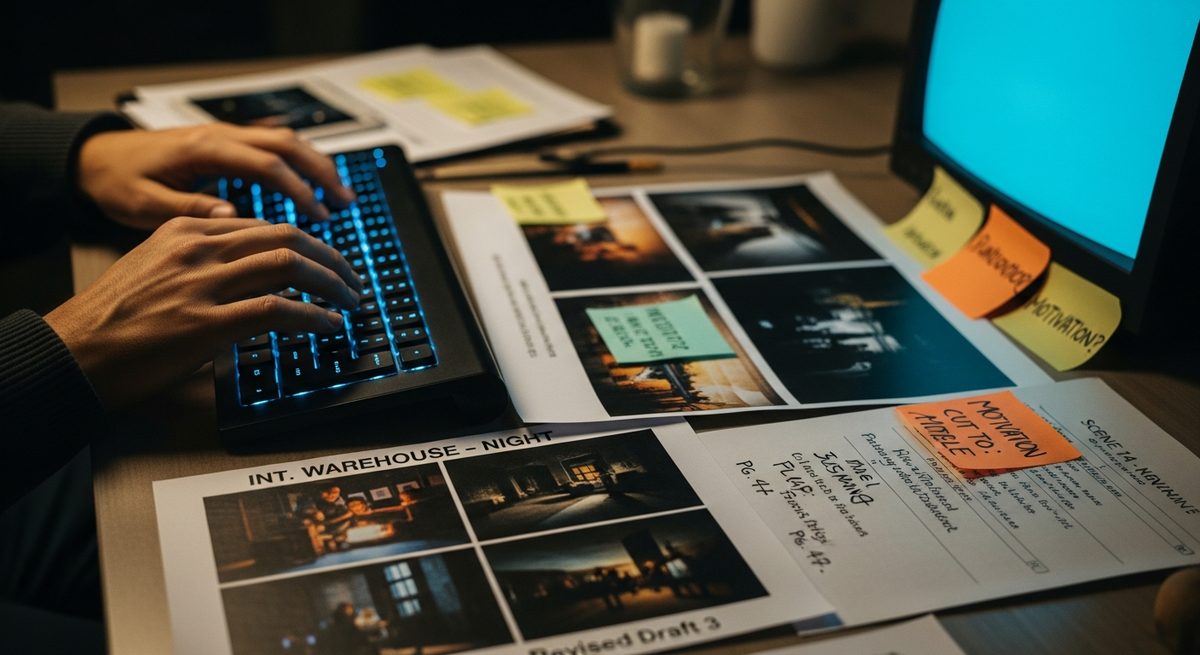
Character and personality do not appear by themselves
The most common failure I see in AI production is this: generic performances. Figures moving through a scene with no interiority, no specificity, no sense that someone made a decision about who this person is and what they are feeling. The work looks produced. It does not feel directed.
Character and personality can absolutely be built through system prompts. I know because we do it, frame by frame. But it takes the same things it has always taken: craft, vision, and the willingness to iterate until the work is right rather than stopping when it is merely acceptable.
The director's instinct, that understanding of what a performance needs, what a frame is missing, what a grade should feel like, does not become redundant in AI production. It becomes more essential, because the tool will not supply it for you. The average is always one prompt away. Getting past the average is always the director's problem to solve.
See how Sensa directs AI production from brief to final frame. Explore our AI work →
What to look for when you are hiring
Whether you are bringing someone in-house or commissioning a production company, the evaluation criteria have not changed. For internal hires, the question is not whether they have access to AI tools. Everyone has access to AI tools. The question is what they are bringing creatively. How are they directing your commercials? What is their instinct? What is their vision?
For a production company, look at the portfolio. How creative is the AI work? How consistent is it across a project? How convincing is the integration? These have always been the questions. The medium is newer than the criteria.
At Sensa, we are a production house. We direct every frame, whether it is shot on a camera or generated through our studio software. The hybrid approach we use, real cinematography and AI production working in the same pipeline, is only coherent because the direction is consistent across both. That coherence does not come from the technology. It comes from having a point of view and being disciplined enough to apply it to every single frame.
The real question behind every AI production
There is a question I ask before any project begins, and it is the same question I have always asked: what is the single feeling a viewer should leave with? Once that is answered, every decision, every prompt, every reference frame, every grade, is in service of it. Without that answer, you are just generating.
AI in the hands of a filmmaker who understands it, who has studied the tools, who brings genuine creative vision and is given the time and freedom to execute properly, can produce something remarkable. I have seen it. We have made it. But the word that does the work in that sentence is filmmaker, not AI.
The tools are new. The discipline is not. Direction still matters in AI filmmaking because it has always been the only thing that mattered.
What changes in AI production — and what does not
The tools are new. The discipline is not.
Two columns: everything that changed in AI production, and everything that did not.
The tool will never be the variable that separates remarkable work from mediocre work. The person wielding it always will be.
Sensa Productions is a global AI video production house: an award-winning studio that creates bespoke, brand-accurate films with hybrid AI and human craft, directed frame by frame on its own studio software. If you want AI work that goes beyond the average, start with a conversation.